
Blog
Vape Nicotine Strengths Explained: How to Read mg/mL, Percentages and Salt Labels
Oct
Vape packaging uses numbers that can be confusing if you are new to vaping. Milligrams per millilitre, percentages, and terms such as ‘nicotine salts’ all describe the same thing in different ways: how much nicotine is in the e-liquid. Once you understand the labels, it is easier to choose a strength that suits you and to avoid taking in more nicotine than you intended.
What does mg/mL mean?
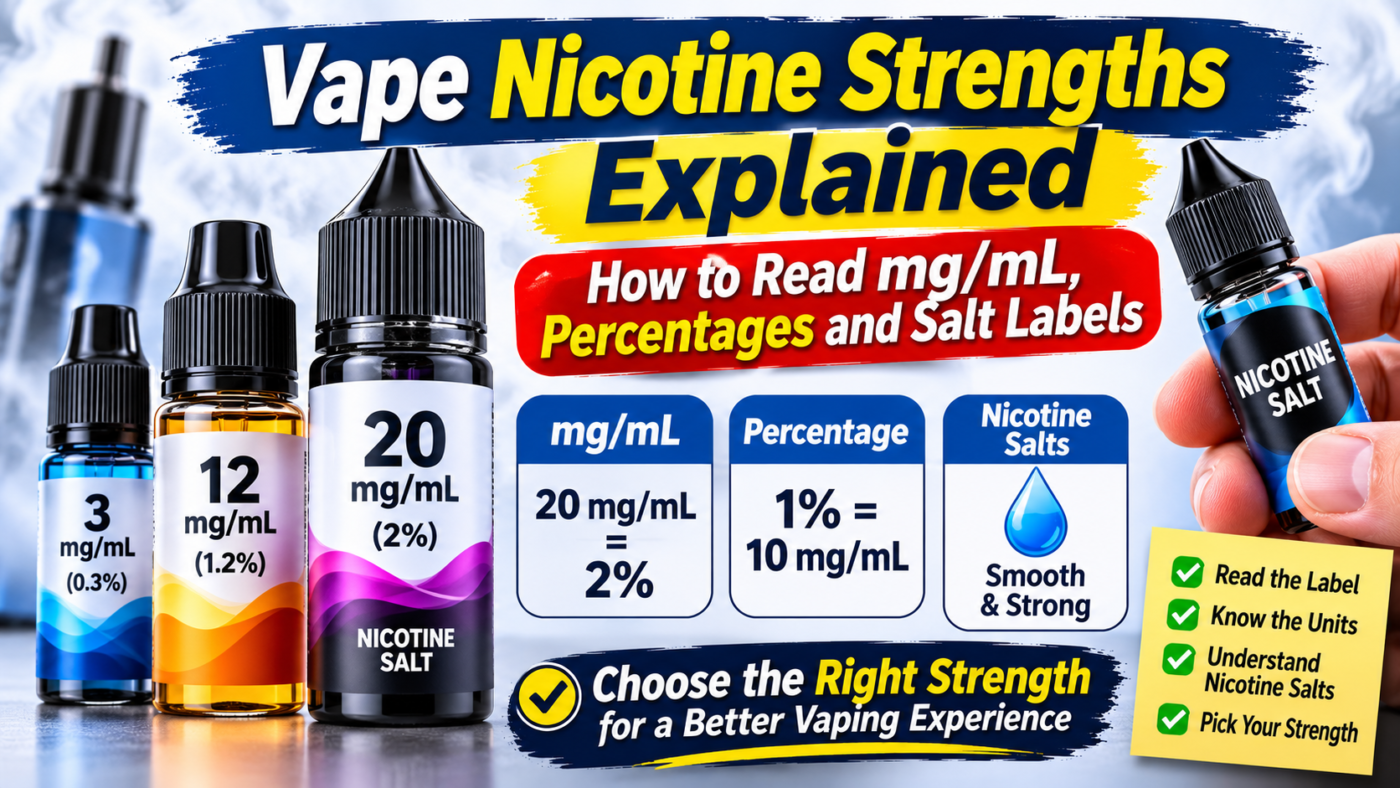
The most common unit is milligrams per millilitre, written as mg/mL. A bottle labelled 20 mg/mL contains 20 milligrams of nicotine in every millilitre of liquid. A 10 mL bottle at that strength therefore contains 200 milligrams of nicotine in total. Higher numbers mean stronger e-liquid. Common strengths include 3 mg/mL, 6 mg/mL, 12 mg/mL, and 20 mg/mL, although the range varies by country and brand.
Percentages
Some labels use a percentage instead. A 2% e-liquid contains the same amount of nicotine as a 20 mg/mL e-liquid. The conversion is simple: 1% equals 10 mg/mL. A 0.6% e-liquid is therefore 6 mg/mL, and a 1.2% e-liquid is 12 mg/mL. Manufacturers sometimes use one unit on the front of the packaging and the other on the back, so it is worth checking both.
Nicotine salts vs freebase nicotine
E-liquids use two main forms of nicotine. Freebase nicotine is the form used in most older e-liquids. It can feel harsh at higher strengths, which is why freebase e-liquids are usually sold at lower concentrations. Nicotine salts are a newer form that is less harsh, allowing manufacturers to sell higher strengths without the same throat irritation. Salt nicotine is often used in pod systems and disposables, where a smooth draw is important. The label may say ‘nic salt’, ‘salt nic’, or ‘nicotine salts’.
Reading a label in practice
Start by looking for the nicotine strength, which is usually printed on the front of the bottle or device. Check whether it is in mg/mL or as a percentage. If the label says ’20 mg/mL’ and ‘2%’, those are the same strength. Look for the type of nicotine: freebase or salt. If you are switching from smoking, a higher strength may be more satisfying at first. If you vape frequently, a lower strength may be more comfortable. Always follow the manufacturer’s instructions and store e-liquid out of reach of children.
Why the same number feels different
Two e-liquids with the same nicotine strength can feel different because the device matters. A high-powered device produces more vapour per puff, so it delivers more nicotine even if the liquid is the same strength. A low-powered pod system produces less vapour, so the same liquid feels weaker. Your inhalation style also matters. Direct-to-lung vaping draws more vapour than mouth-to-lung vaping, and therefore delivers more nicotine per puff. In the United Kingdom, government guidance on e-cigarette regulations restricts nicotine content to 20 mg/mL and sets rules on labelling and packaging, which helps explain why UK products use the numbers they do.
Choosing a strength
There is no single strength that works for everyone. Light smokers may find 3 mg/mL or 6 mg/mL enough, while heavier smokers may prefer 12 mg/mL or 20 mg/mL. If you are unsure, start lower and increase only if you still feel cravings. Pay attention to how you feel after vaping, and do not assume that a higher number is always better. Adults in Australia who order cheap cigarettes online tend to reorder the same brand and strength, and the same logic applies to vaping: once you find a strength that works, there is little reason to keep changing it.
The numbers on the label are not as complicated as they first appear. Milligrams per millilitre and percentages describe the same thing, and the type of nicotine affects how smooth the vapour feels. Use the label, the device, and your own experience to choose a strength that suits you.
